











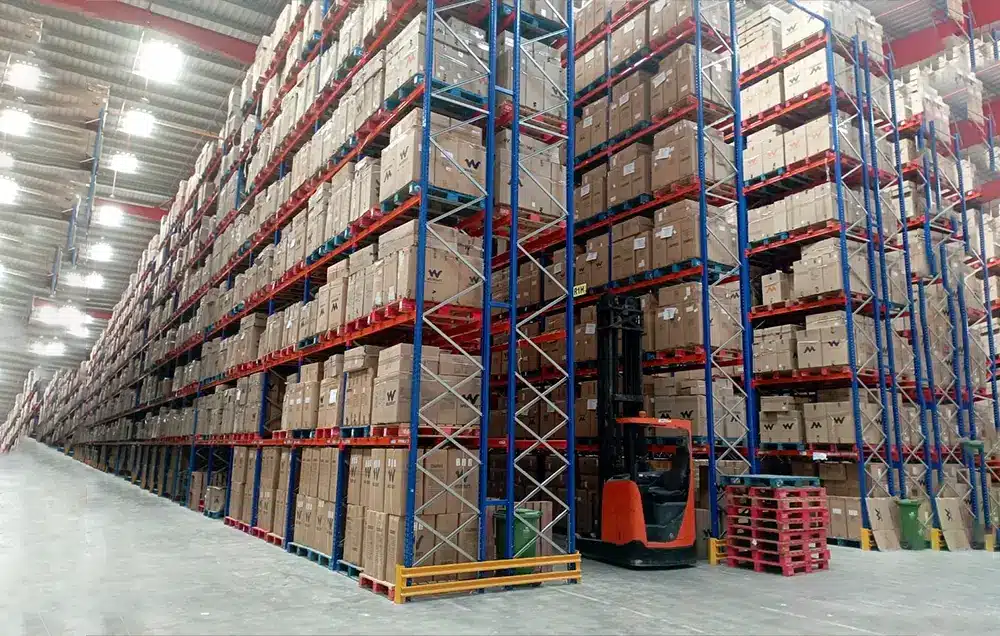
A practical guide to understanding warehouse racking, types, load capacities, how to choose, and what separates a good manufacturer from a bad one.
A Quick answer
A warehouse racking system is a steel storage framework that lets you stack goods vertically and Organize them horizontally; so, you stop wasting floor space. But there’s no universal answer here. What works in a cold storage facility won’t work for an auto parts distributor. The right racking solution depends on the purpose, or the material you are storing, the weight of the rack, and how often it is needed to be accessed.
What is a Warehouse Racking System?
Put simply: it’s a metal structure — almost always high-grade steel — built to hold goods on multiple levels. Instead of stacking everything on the floor and hoping for the best, racking lets you use the full height of your facility. Forklifts, reach trucks, or workers on foot can access stock at each tier.
What’s changed in recent years is how engineered these systems have become. Good racking is built around how your warehouse actually operates, not just the size of your space. It’s designed around your specific load types, how often stock rotates, and which equipment your team operates every day
When does high-density racking make sense?
When you’ve run out of floor space but still have ceiling height. High-density warehouse racking system squeezes more pallets into the same footprint, but they come with trade-offs, mainly around how easily you can access individual SKUs.
If every square metre cost money, high-density racking is usually worth the investment. The question is which type, because not all high-density systems work the same way.
What separates a good provider here is whether they start with your layout or their product brochure. The better ones, like Metal Storage Systems, visit the site first, understand your workflow, and then recommend a system. The others hand you a spec sheet.
Types of Warehouse Racking System: Which One Fits Your Operation?
| Type | Best for | Rotation | Density | Forklift |
| Selective pallet | Mixed SKUs, e-commerce | FIFO / any | Medium | Standard |
| Drive-in | Bulk, cold storage, FMCG | LIFO | Very high | Drives into lane |
| Push-back | Medium SKU count, distribution | LIFO | High | Front-aisle only |
| Cantilever | Pipes, timber, long loads | Any | Medium | Side-loader |
| Heavy-duty | Industrial equipment, machinery | Any | Medium | Heavy counterbalance |
| Mezzanine | Multi-level pick, retail backroom | Any | High (vertical) | Manual / conveyor |
| Flow / FIFO | Perishables, pharma, food | FIFO | High | Standard |
How to Evaluate a Racking Provider: What Actually Matters
The honest answer is that most providers will tell you they offer “custom solutions” and “end-to-end service.” The difference shows how they start the conversation.
A provider worth working with will want to understand your floor plan, your stock movement patterns, and your forklift aisle widths before they recommend anything. If the first thing they send you is a product catalogue, that’s a sign they’re fitting your warehouse to their inventory — not the other way around.
A few things worth checking before you commit:
- Do they have sector experience that matches yours? Cold storage, pharma, and automotive all have specific requirements that a general racking supplier might miss.lpndian pride porrtal
- Are load ratings calculated for your actual pallet dimensions and floor slab capacity — or are they generic catalogue figures?
- Who handles installation? If it’s subcontracted out, ask who’s accountable when something doesn’t line up.
- What happens two years from now if a beam gets damaged? Spare parts availability and response times matter more than most buyers realise upfront.
- Ask for steel test reports, not just brochures. IS-standard certification should be straightforward to produce.
Load capacity: what the numbers actually mean
| Category | Load per beam level | Typical use cases |
| Light-duty | Up to 500 kg | Retail backrooms, small parts |
| Medium-duty | 500 – 1,500 kg | FMCG, general distribution |
| Heavy-duty | 1,500 – 4,000 kg | Automotive, industrial components |
| Very heavy-duty | 4,000 kg+ | Steel, construction materials, machinery |
These are indicative ranges; hence, it is important to treat them as a starting point, not a specification. Real load ratings depend on your pallet dimensions, your floor slab capacity, and your seismic zone. Never use catalogue figures as your final number.
Which Industries Use Warehouse Racking?
Racking isn’t just for logistics companies. Any operation that holds stock at scale — whether that’s finished goods, raw materials, or components — benefits from a structured storage system. The sectors that invest most heavily tend to be:
- E-commerce & retail
- FMCG & consumer goods
- Cold storage & frozen
- Automotive & auto parts
- Pharma & healthcare
- Electronics manufacturing
- Food & beverage
- Tyre & rubber
- Steel & construction
- Government & defence
- Aviation & aerospace
- Textile & garments
FAQs:
Q1: How do I choose the right warehouse racking system for my facility?
Every warehouse is a bit different, honestly. What works for a pharma unit won’t suit an auto parts distributor. Metal Storage Systems starts with a site visit rather than pushing a catalogue, which makes a real difference when matching a system to an actual workflow.
Q2: Is a warehouse racking system capable of handling heavy industrial loads?
Yes, but it is very crucial to get the right math done for your setup and not just copy numbers off a spec sheet. The team at Metal Storage Systems works out ratings based on your pallet dimensions and floor slab, which is especially important once you’re dealing with heavy duty applications.
Q3: How long does a warehouse racking system typically last?
Realistically, 20 plus years if it’s built right and not being ignored. Metal Storage Systems uses high tensile steel with tight fabrication tolerances, so wear is rarely the issue. Forklift damage that goes unchecked tends to be a bigger problem than the racking itself aging out.